
Raw and refined, city and bush
“Taken together, the site may be considered as an irregular amphitheatre – with Ainslie at the north-east in the rear, flanked on either side by Black Mountain and Pleasant Hill, all forming the top galleries…”
Walter Burley Griffin, The Federal Capital: Report Explanatory of the Preliminary General Plan (1913)
What is raw is then refined. Raw becomes cooked. Matter takes form. These are linear relationships: the transformation of substance into form seems like a strictly one-way process.
But does the processed state really supersede its raw beginning? This view aligns with hylomorphism, in which an inert, passive substance is stamped with a fixed form. Writers like Tim Ingold argue for a two-way interaction between form and substance, such as the way a woodworker works around the grain of timber.
Why does this matter here? Well, Canberra embodies a contradiction as both a “designed city” and “bush capital”. The regularity of the city’s refined urban design seems to contrast with the rawness of its bush surrounds. This becomes especially relevant now that it is bidding to be a UNESCO Creative City for Design.
Phoebe Porter’s Raw and Refined series appears at the perfect time to help make sense of this paradox.
For more than a decade, Porter has created jewellery that juxtaposes raw and refined metal. Her Seven Grams necklace (2015) combined native gold (collected by her grandfather in Papua New Guinea) with its equivalent weight in stainless steel. This year, her Raw and Refined earrings balance her grandfather’s native gold with a cylinder of processed 750 yellow gold. Other works make a similar combination using native gold sourced from Round Mountain Mine, Nevada, and the Kimberley, Western Australia.
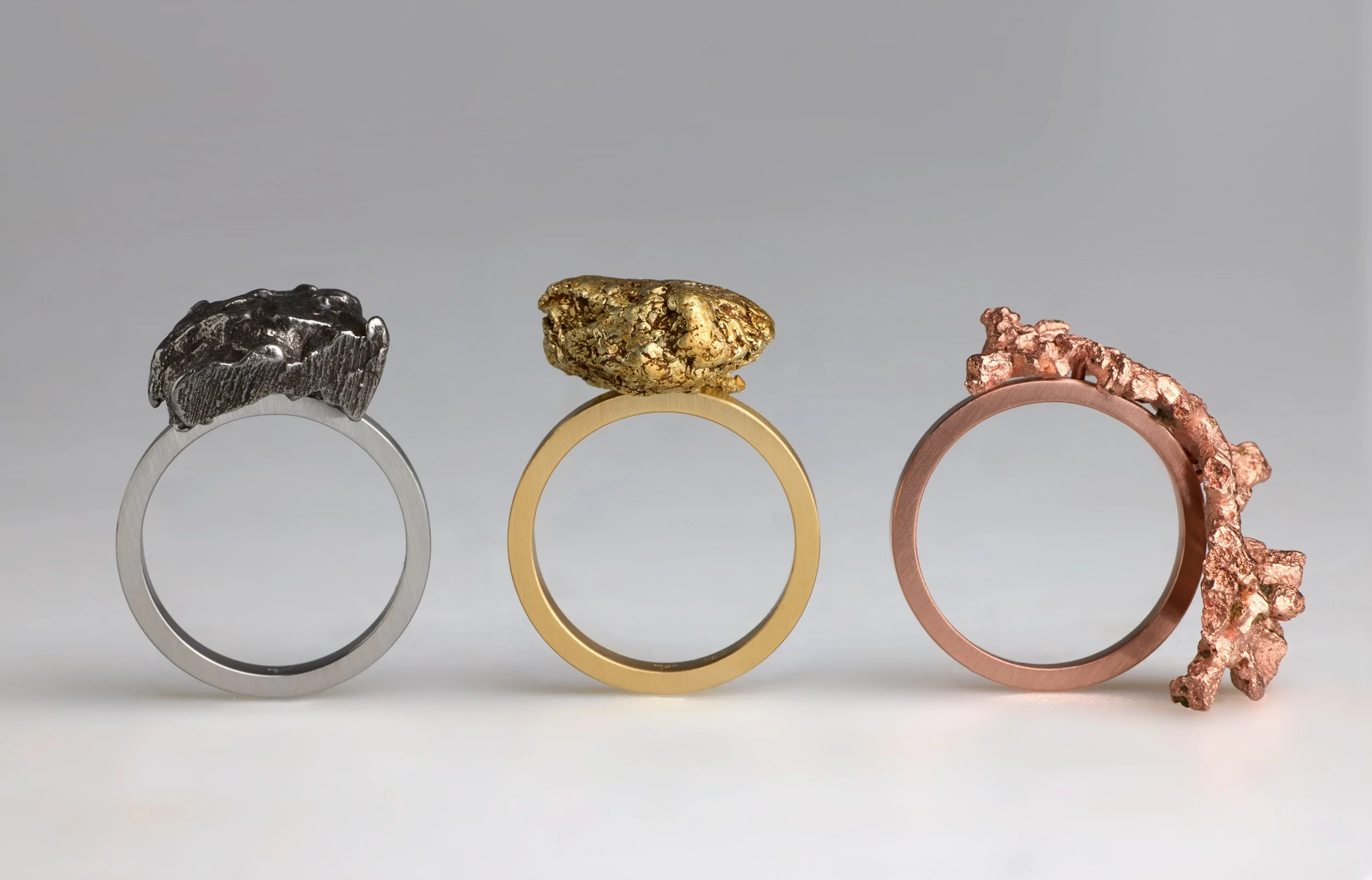
She has created similar juxtapositions in necklaces, rings and earrings with native copper (Kazakhstan, Michigan and Cloncurry, QLD) and iron octahedrite (Argentina). The specimens were partly sourced through mineral dealers at the Canberra Rock Swap. The gold ring and the copper ring have been hand-fabricated, scored, soldered, hammered round, and finished. The stainless steel ring has been turned from a solid rod.
These raw and refined elements are balanced like yin and yang on either ear, of similar weight in a necklace or fitted over a ring. Porter’s work explores, at an intimate scale, the dialectic of nature and culture that is idiomatic of Canberra.
Through jewellery, we understand what is truly precious in the world. While this has conventionally been measured by the monetary value of metals and stones, the contemporary jewellery movement has sought to critique it by focusing on creativity, often using non-precious materials such as aluminium and plastic. In Phoebe Porter's work, she challenges this by combining processed and unprocessed materials.
This method enables Porter to explore jewellery as an expression of value. As she says, “That is a main interest of the contemporary jewellery movement: looking at jewellery, which is an object laden with meaning and value. You pull apart what within that is the value of the materials, the value of the skill in creating it, the value in the ideas, and then the value in all the personal meaning of the person who has owned it or worn it or gifted it or inherited it.”
The preciousness of native materials has antecedents. In nineteenth-century Australia, gold rush jewellery often highlighted raw nuggets as trophies. The Arts & Crafts movement favoured natural stones such as opal and turquoise over faceted diamonds. On this side of the world, the stone, bone and shell movement in Aotearoa New Zealand sought to highlight the natural beauty of local materials, realised through traditional Māori forms of adornment.
Rather than simply highlighting natural materials, Porter combines them evenly with their processed versions, in which she was trained. She learned jewellery at the Canberra School of Art under Johannes Kuhnun. Kuhnen was a product of the German Goldschmiede tradition, which favoured industrial materials, geometric construction and machined precision. This has influenced Porter's commitment to hands-on studio practice. She reflects on her working method: "On the lathe, I'm turning all the wheels myself, by hand. It lets you get really precise shapes. Industrial materials like titanium, aluminium and stainless steel became real hallmarks of my work."
Porter adds something unique to this machined aesthetic: a sense of place. For the exhibition Solutions for Better Living (2007), curated by Kate Rhodes at Craft Victoria, she worked with Blanche Tilden to develop a system that lets wearers mix and match elements on a brooch. General Assembly referenced Wilson Parking signs, representing Melbourne's urban identity. Rather than use a prefabricated tourist icon like the Melbourne tram, the project let the city's identity emerge organically from its urban ecosystem. A sequel was staged in Canberra, which referenced the city's roundabouts.
Porter’s creative use of a system to reveal a sense of place resonates with modernist art practice. Porter admires the work of James Turrell, especially the Skyspaces series, consisting of architectural chambers with a precisely engineered aperture cut into the ceiling, open to the sky. The work's purpose is simply to frame what exists outside it and heighten our perception. A similar effect can be found in John Cage's 4'33", in which the musician performs the formal ritual of performance in a concert hall only to allow the ambient sounds that would naturally occur to be heard.
This can be understood philosophically in different ways. Heidegger's concept of gestell, the technological capture of nature, contrasts with poiesis, an unconcealing in which something reveals itself on its own terms. Derrida develops a more formal account of unconcealment through the concept of parergon in Truth in Painting: the frame sits outside the painting but is critical to marking the break with the outside world in which art can occur.
This fits well in the context of Canberra, which operates like an aperture to the surrounding bush. The Griffins' land axis runs from Mount Ainslie through Capital Hill to Bimberi Peak, with the city sited centrally between three hills, Black Mountain, Mount Ainslie and Mugga Mugga. A water axis runs through an ornamental lake made of linked basins. The artificial Lake Burley Griffin functions like a Skyspace, reflecting its bush surrounds.
Porter reveals an organic beauty in metal similar to what we find in nature: “You look at the different crystalline forms and colours, and they make you think of things you've seen in the natural world, whether rock formations or leaf structures or clouds.”
For Phoebe Porter, the refined element is the aperture through which we can appreciate the raw. This makes her the perfect jeweller for this time and place.
Dr Kevin Murray, 2026
“For Phoebe Porter, the refined element is the aperture through which we can appreciate the raw. This makes her the perfect jeweller for this time and place.”
DR KEVIN MURRAY, Writer and curator, GARLAND MAGAZINE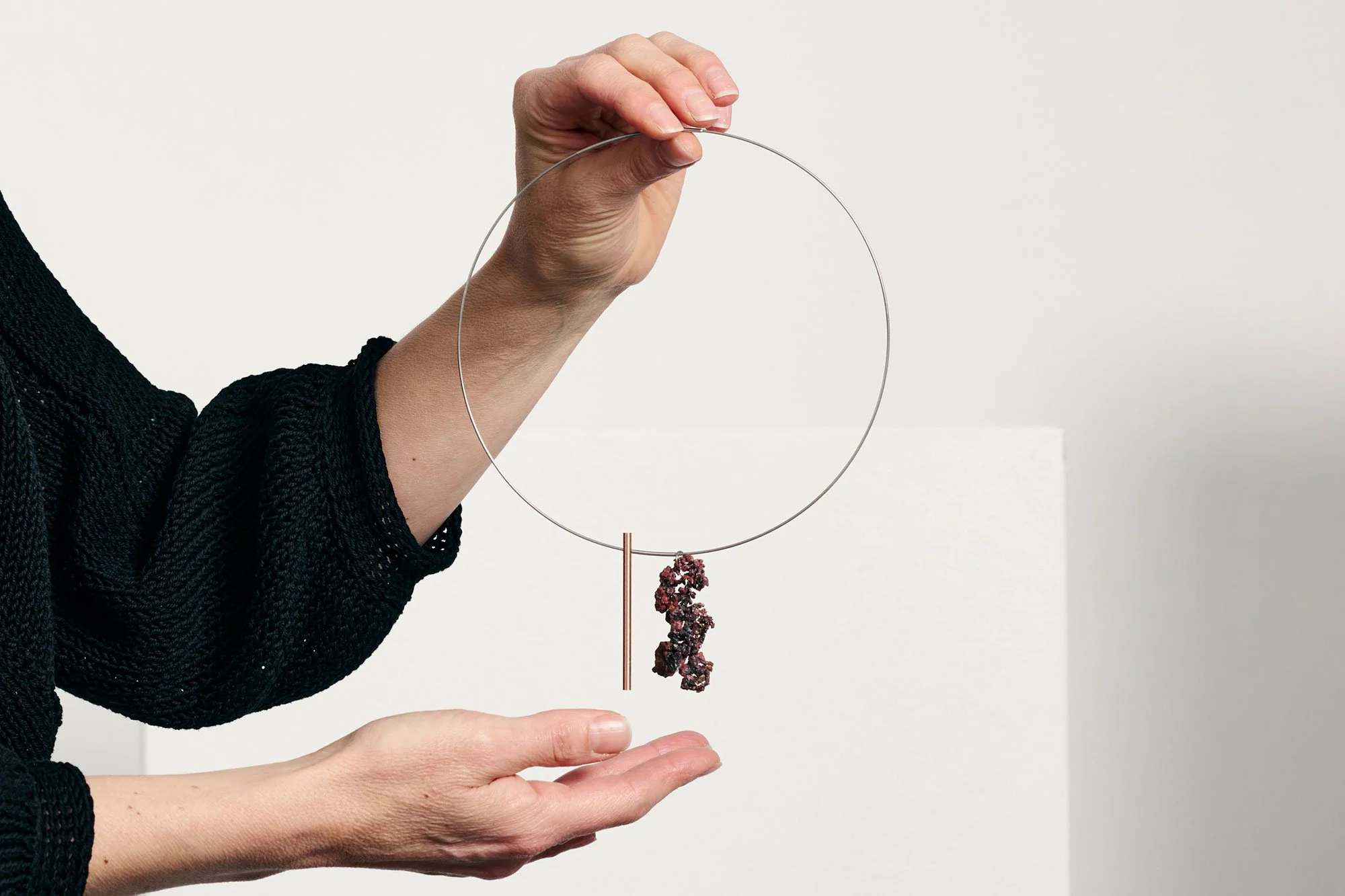

RAW AND REFINED, CITY AND BUSH

“Taken together, the site may be considered as an irregular amphitheatre – with Ainslie at the north-east in the rear, flanked on either side by Black Mountain and Pleasant Hill, all forming the top galleries…”
Walter Burley Griffin, The Federal Capital: Report Explanatory of the Preliminary General Plan (1913)
What is raw is then refined. Raw becomes cooked. Matter takes form. These are linear relationships: the transformation of substance into form seems like a strictly one-way process.
But does the processed state really supersede its raw beginning? This view aligns with hylomorphism, in which an inert, passive substance is stamped with a fixed form. Writers like Tim Ingold argue for a two-way interaction between form and substance, such as the way a woodworker works around the grain of timber.
Why does this matter here? Well, Canberra embodies a contradiction as both a “designed city” and “bush capital”. The regularity of the city’s refined urban design seems to contrast with the rawness of its bush surrounds. This becomes especially relevant now that it is bidding to be a UNESCO Creative City for Design.
Phoebe Porter’s Raw and Refined series appears at the perfect time to help make sense of this paradox.
For more than a decade, Porter has created jewellery that juxtaposes raw and refined metal. Her Seven Grams necklace (2015) combined native gold (collected by her grandfather in Papua New Guinea) with its equivalent weight in stainless steel. This year, her Raw and Refined earrings balance her grandfather’s native gold with a cylinder of processed 750 yellow gold. Other works make a similar combination using native gold sourced from Round Mountain Mine, Nevada, and the Kimberley, Western Australia.
She has created similar juxtapositions in necklaces, rings and earrings with native copper (Kazakhstan, Michigan and Cloncurry, QLD) and iron octahedrite (Argentina). The specimens were partly sourced through mineral dealers at the Canberra Rock Swap. The gold ring and the copper ring have been hand-fabricated, scored, soldered, hammered round, and finished. The stainless steel ring has been turned from a solid rod.
These raw and refined elements are balanced like yin and yang on either ear, of similar weight in a necklace or fitted over a ring. Porter’s work explores, at an intimate scale, the dialectic of nature and culture that is idiomatic of Canberra.
Through jewellery, we understand what is truly precious in the world. While this has conventionally been measured by the monetary value of metals and stones, the contemporary jewellery movement has sought to critique it by focusing on creativity, often using non-precious materials such as aluminium and plastic. In Phoebe Porter's work, she challenges this by combining processed and unprocessed materials.
This method enables Porter to explore jewellery as an expression of value. As she says, “That is a main interest of the contemporary jewellery movement: looking at jewellery, which is an object laden with meaning and value. You pull apart what within that is the value of the materials, the value of the skill in creating it, the value in the ideas, and then the value in all the personal meaning of the person who has owned it or worn it or gifted it or inherited it.”
The preciousness of native materials has antecedents. In nineteenth-century Australia, gold rush jewellery often highlighted raw nuggets as trophies. The Arts & Crafts movement favoured natural stones such as opal and turquoise over faceted diamonds. On this side of the world, the stone, bone and shell movement in Aotearoa New Zealand sought to highlight the natural beauty of local materials, realised through traditional Māori forms of adornment.
Rather than simply highlighting natural materials, Porter combines them evenly with their processed versions, in which she was trained. She learned jewellery at the Canberra School of Art under Johannes Kuhnun. Kuhnen was a product of the German Goldschmiede tradition, which favoured industrial materials, geometric construction and machined precision. This has influenced Porter's commitment to hands-on studio practice. She reflects on her working method: "On the lathe, I'm turning all the wheels myself, by hand. It lets you get really precise shapes. Industrial materials like titanium, aluminium and stainless steel became real hallmarks of my work."
Porter adds something unique to this machined aesthetic: a sense of place. For the exhibition Solutions for Better Living (2007), curated by Kate Rhodes at Craft Victoria, she worked with Blanche Tilden to develop a system that lets wearers mix and match elements on a brooch. General Assembly referenced Wilson Parking signs, representing Melbourne's urban identity. Rather than use a prefabricated tourist icon like the Melbourne tram, the project let the city's identity emerge organically from its urban ecosystem. A sequel was staged in Canberra, which referenced the city's roundabouts.
Porter’s creative use of a system to reveal a sense of place resonates with modernist art practice. Porter admires the work of James Turrell, especially the Skyspaces series, consisting of architectural chambers with a precisely engineered aperture cut into the ceiling, open to the sky. The work's purpose is simply to frame what exists outside it and heighten our perception. A similar effect can be found in John Cage's 4'33", in which the musician performs the formal ritual of performance in a concert hall only to allow the ambient sounds that would naturally occur to be heard.
This can be understood philosophically in different ways. Heidegger's concept of gestell, the technological capture of nature, contrasts with poiesis, an unconcealing in which something reveals itself on its own terms. Derrida develops a more formal account of unconcealment through the concept of parergon in Truth in Painting: the frame sits outside the painting but is critical to marking the break with the outside world in which art can occur.
This fits well in the context of Canberra, which operates like an aperture to the surrounding bush. The Griffins' land axis runs from Mount Ainslie through Capital Hill to Bimberi Peak, with the city sited centrally between three hills, Black Mountain, Mount Ainslie and Mugga Mugga. A water axis runs through an ornamental lake made of linked basins. The artificial Lake Burley Griffin functions like a Skyspace, reflecting its bush surrounds.
Porter reveals an organic beauty in metal similar to what we find in nature: “You look at the different crystalline forms and colours, and they make you think of things you've seen in the natural world, whether rock formations or leaf structures or clouds.”
For Phoebe Porter, the refined element is the aperture through which we can appreciate the raw. This makes her the perfect jeweller for this time and place.
Dr Kevin Murray, 2026
Selected pieces from Raw and Refined are available to purchase.